
THE MAGIC OF COLOR - DYE
Most cloth is dyed before it is a garment. The yarn goes in the bath, or the flat fabric does, and it comes out one flat, even, correct color — and then somebody cuts a shirt out of it. This is efficient. This is how nearly every shirt you have ever owned was made.
We do it backwards. And so did they.
The shirt is cut and sewn first, out of plain white cotton. Then the whole finished garment goes into the bath — collar, hems, seams, all of it — and it tumbles there for hours, with stones, turning over and over in the dye like a rock in a river.
It does not come out even.
The seams take the dye differently than the body. The collar drinks differently than the sleeve. The doubled fabric at the hem holds less. Every shirt comes out of that bath slightly different from every other shirt, and the mill does not call this a defect. Their own words:
"Shade variations are inherent in the pigment dye process."
The garment gets a history before you ever put it on.
By the time it reaches your hands it has already been through the equivalent of fifty washes. It is already soft. It is already broken in. It is already, in the only way that matters, old.
That is not a marketing claim. That is what happens in the drum.
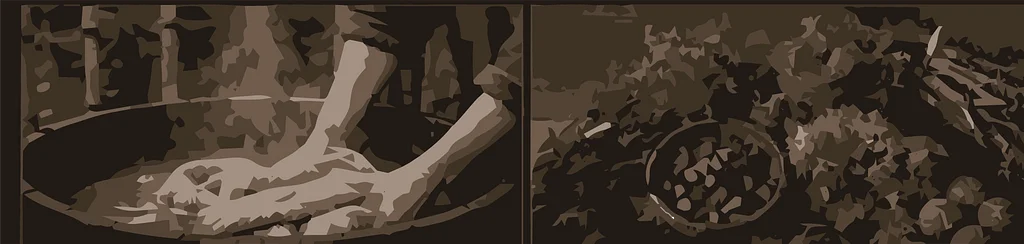
Garment-dyed cloth is dyed after construction. Piece-dyed cloth is dyed before. The difference you can feel with your hands.
Most of our color is pigment dye — the pigment binds to the surface of the fiber rather than chemically bonding into it. This is what produces the muted, earthy, faded look, and it is why the color keeps softening over the life of the garment instead of simply dying. A pigment-dyed shirt at five years old looks better than it did new. That is the entire point.
A smaller number of our colors are reactive-dyed — the dye bonds chemically into the fiber, giving a deeper, truer tone. Both are garment-dyed. Both are ring-spun. They simply age differently.
THE PALETTE
There is no neon in this line and there never will be.
Look at what we offer. Stones, clays, rusts, muted earths, and the deep quiet colors.
That is not a style choice. That is what cloth does when you don't force it.
A Norse dyer had woad for blue, madder for red, weld and lichen for yellow, iron and tannin for the darks. That was the range. That was all the range there was — and it is almost exactly the range a pigment dye bath will give you today.
Fewer choices. Every one of them a color they could actually have made.
Our pink is salmon, because madder root gives you salmon. It does not give you anything louder.
And neither will we.
HISTORY REVEALS ITSELF
And this part is not ours. In August of 2025, a team from Moesgaard Museum began digging at Søften, ten kilometres north of Aarhus, in East Jutland. They dug for ten months. They found eighty-two pit houses. Spindle whorls. Loom weights. An area for processing flax. Arabic silver, Frankish coin, German coin — the trade that comes to a place because the place is making something worth coming for. It was a textile production centre. A factory. Running from roughly 600 to 950 AD. A whole settlement, for three hundred years, whose entire business was making cloth. Everyone knows about the raiding. The sagas are full of it and so are the films. Almost nobody knows the Norse ran cloth as an industry — that it was skilled, organized, technical work, done at scale, and that it paid. Somebody dug that up. Somebody stood in the Danish weather for ten months and found where the cloth came from. Thank You for your hard work and dedication!
THE INK
Pigment-dyed cotton has a hard ceiling: 320°F fabric temperature.
Above that, the pigment does not merely misbehave. It scorches, shifts, or dies permanently. The color that goes into the dryer is not the color that comes out, and there is no recovering it.
That constraint governs every printing decision we make.
Temperature strip on the first run of every job. No exceptions.
Slow the belt. A hotter, faster cure will cross 320°F without anyone noticing until the shirts are already ruined.
DTG, not DTF. Water-based ink bonds into 100% cotton fiber. Film transfers sit on top of it. We do not put things on top of the cloth.
Nothing that fights the garment. The entire reason to buy a garment-dyed shirt is that the color lives in the fabric. Cooking it with a bad cure defeats the purpose of the blank.
This is why we print the way we print.
Not preference. Chemistry.
WHAT IT ADDS UP TO
One continuous strand, because the short ones fail.
Dyed after it is a shirt, because that is how it gets a history.
The colors the land actually gives, because that is what they had.
Nothing on top of the cloth.
Four rules. One reason.
Warriors stand against everything. Cheap cloth doesn't.
Strong enough to lash to a mast. Not that you should. But you could.
Like a rock in the storm. We stand fated.
ᛏᚱᛁᚴᛋ · ᚢᚱᚦᚱ
Skál.